
Small amounts of mold found inside Sophie the Giraffe or other baby toys generally do not cause serious illness in healthy children. However, mold can trigger symptoms in children with asthma, mold allergies, or weakened immune systems. If your baby develops coughing, wheezing, irritated eyes, or another concerning symptom after playing with Sophie the Giraffe, contact your pediatrician. Learn more from Cleveland Clinic’s pediatric guidance.
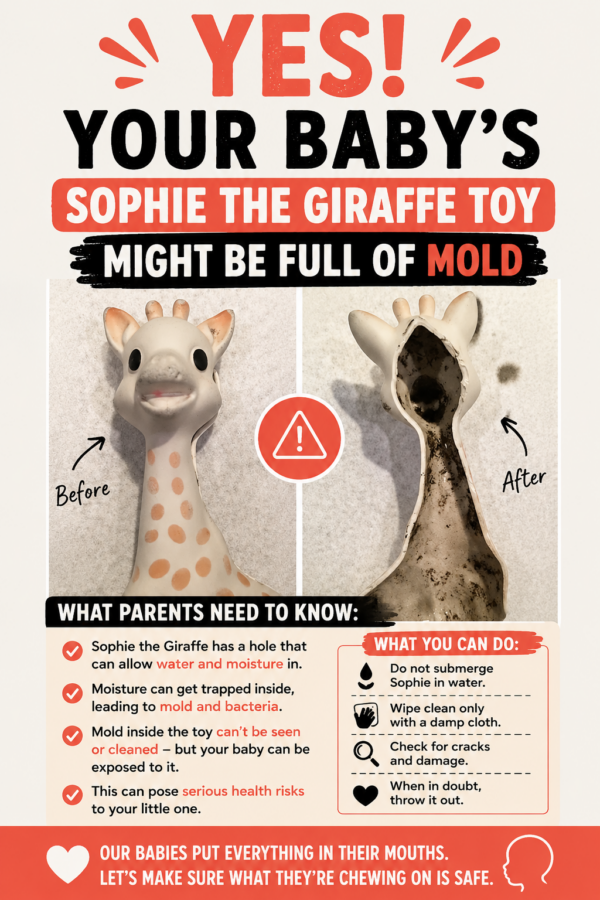
How the Sophie the Giraffe Mold Concern Began
Important update: This article was originally published in 2017 after parents reported finding mold inside their Sophie the Giraffe toys. It has been updated with current manufacturer care instructions. Sophie should be surface-cleaned only and should never be rinsed, submerged, sterilized, boiled or placed in the dishwasher.
Sophie the Giraffe has been a popular baby teether for years, but reports of mold found inside some toys have understandably worried parents. Because Sophie has a squeaker opening, moisture can potentially become trapped inside if the toy is rinsed, submerged or cleaned incorrectly.
This is a good reminder that even popular children’s toys need to be checked regularly for damage, moisture, and other potential safety concerns. I recently shared more practical advice in my guide to toy safety warnings parents should know about, including what to watch for with today’s popular squishy toys.
This doesn’t mean that every Sophie contains mold or that parents should panic. Here’s what the manufacturer recommends, what signs to watch for and when replacing the toy may be the safest option.
Recently, pediatric dentist Dana Chianese, who herself is a mama to two young boys, was cleaning some of her youngest’s toys, and noticed that the air coming out of his Sophie The Giraffe smelled musty. “I decided to cut into Sophie out of curiosity and discovered a science experiment living inside,” Chianese told Goodhousekeeping.com. “Smelly, ugly mold living in my infant’s favorite chew toy!”

Parents Report Finding Mold Inside Sophie the Giraffe
Chianese explains to GoodHousekeeping that she always cleaned the toy according to instructions, using hot, soapy water with a damp sponge and never submerging it into water. “It still hurts my heart to know that for months I allowed my babies to chew on moldy toys,” she says. “I no longer buy any chew toys with a hole or recommend any to my patients.”
And Chianese is not the only one to have made a rather grim discovery about her baby’s favorite chew toy. On Amazon, one reviewer tried to alert others to what she found when she cut the legs off of her child’s Sophie toy and even shared a picture for proof:

Why Can Moisture Become Trapped Inside?
“Beware!! If you have a drooly baby, moisture will get in the hole and you’ll end up with mold!” says Amazon user Stephanie Opera. “We’ve had ours for two years and the entire inside is coated with black mold!”
Ok. I don’t know about you guys but I definitely do not want my baby eating mold. I got a Sophie The Giraffe for my daughter when she was a baby and it was one of her favorite toys. Yikes! A few months ago, I donated some toys to Goodwill and Sophie was one of the items I gave away. Unfortunately, I didn’t know at that time about the mold.

How to Clean Sophie the Giraffe Safely
According to the manufacturer:
- Wipe the outside with a clean cloth dampened with mild, soapy water.
- Keep the squeaker hole covered while cleaning so water cannot enter.
- Do not rinse or submerge the toy.
- Do not sterilize, boil or place Sophie in the dishwasher.
- Wipe away any soap and allow the exterior to dry completely before giving it back to your baby.
Always follow the care instructions included with your specific product, as recommendations can vary among different Sophie toys.
When Should You Replace Sophie?
Replace or discard the toy if:
- It smells musty or unpleasant.
- You see mold, dark residue or liquid coming from the opening.
- The rubber is cracked, punctured, sticky or deteriorating.
- The squeaker or another part is damaged.
- You cannot confidently keep the interior dry.
Do not cut the toy open and then return it to your child.
Easy-to-Clean Alternatives to Sophie the Giraffe
If you would prefer a teether that is easier to inspect and clean, look for a solid, one-piece design without holes where saliva or water can become trapped. Always choose an age-appropriate product from a reputable manufacturer, follow its specific cleaning instructions, and regularly check it for cracks, loose pieces, or other signs of wear.
Recommended teether types & examples
- Solid food‑grade silicone teethers (ring or pendant shapes) — e.g., Loulou LOLLIPOP, Chewbeads silicone options.
- One‑piece molded silicone teethers with no holes — many brands make “solid” silicone options; check product photos/specs.
- Solid natural rubber toys without suction holes — look for brands like Moonjax that explicitly state “solid” or “no hole.”
- Hardwood teething toys (maple/beech) sealed with food‑grade beeswax or oil — durable and nonporous if well finished.
- Silicone teething keys and rattles that are fully sealed (no removable parts).


For older children who have moved beyond baby teethers, you can also see my list of popular squishy toys kids actually want, along with important safety tips to keep in mind before buying.
Sophie the Giraffe Mold and Cleaning FAQs
Parents often have questions about how to clean Sophie the Giraffe, whether water can enter through the squeaker opening, and what to do if they suspect mold. These quick answers cover the most important cleaning and safety information to help you decide whether to continue using or replace the toy.
Can Sophie the Giraffe go in water?
No. The original Sophie should not be rinsed, submerged, boiled, sterilized or placed in the dishwasher. Clean only the exterior with a damp, soapy cloth while protecting the squeaker opening.
How can I tell whether Sophie has mold inside?
A musty smell, visible discoloration around the opening or dark liquid coming from the toy are reasons to stop using it. Because the interior cannot be thoroughly inspected or cleaned, replacement is the safest choice when something seems wrong.
Does every Sophie the Giraffe contain mold?
No. The reports do not mean every Sophie contains mold. The risk increases if moisture enters through the squeaker opening and remains trapped inside.
How often should a baby teether be replaced?
There is no single replacement schedule for every teether. Inspect it frequently and replace it whenever it becomes cracked, punctured, sticky, discolored or difficult to clean according to its instructions.
Final Thoughts on Sophie the Giraffe Mold
Finding mold inside Sophie the Giraffe can be upsetting, but it doesn’t mean that every Sophie contains mold or that parents need to panic. The best approach is to follow the manufacturer’s cleaning instructions, keep water away from the squeaker opening, inspect the toy regularly, and replace it if you notice a musty smell, damage, discoloration, or other signs that moisture may have entered.
The same careful approach applies to other toys children frequently squeeze, chew, and handle. Before buying another sensory toy, read my guide on how to choose safe squishies for kids, including what materials and warning signs parents should look for.

A good way to prevent mold to get inside of chew toys with a hole on the bottom is to seal the hole with a hot glue gun.
Thank you! Great idea 🙂
We have one that is 12 years old and been through 6 children.
We cut ours open after reading this and ours was as clean as could be.
It looks like it has a seal inside around the squeaker to prevent saliva from getting in. Maybe it is the older ones that do?
Honestly, this is a bunch of fear mongering. And it definitely isn’t “black mold.” Here is what a biologist had to say on the subject:
“Since my news feed has inexplicably been filled with pictures of people murdering their $25 Sophie giraffes, I thought I would do a quick note on mold: a story of facts, fiction, lies, and intrigue. Or something. So here is a message from your friendly biologist about mold.
Mold has somehow gotten a really bad reputation, even though it is literally everywhere and 99.999% harmless. These days, people will look at a picture of mildew and proclaim that it is toxic black mold and that this will cause any number of health problems from asthma to cancer. The truth is that most mold is just random harmless mold.
Most molds are dark, and many of them are black. There are certain types of mold that are considered “toxic,” and these are mostly the Stachybotrys molds that grow into, for example, the drywall of a water damaged house. This is what people are talking about when they say “toxic black mold,” but the truth is that the science is kinda unclear about whether or not even this kind of mold is dangerous, because it doesn’t seem to affect everyone the same way. The general consensus is that there is probably a link between heavy exposure to this type of mold and asthma, particularly in children.
However, most of the mold in your house isn’t this kind of mold. This is certainly not what is growing in your bathroom, or in your bath toys, or in your Sophie giraffe. The mold that you see in these places is probably mostly algae, which isn’t a fungi at all, potentially mixed with some mold, potentially mixed with some bacteria. This sounds and looks disgusting, but the thing is, this delicious mixture is actually coming from your drinking water, mostly, and possibly your body, and possibly the air, but in any event, you are literally covered inside and out with it no matter what you do. Any time someone opens up a bath toy and gets upset about the gunk inside, I have to laugh, because you should seriously see the inside of the pipes that bring your fresh water. You’d never sleep again.
So, when do you need to worry about mold? You should worry about mold if you are immunosuppressed, have a specific allergy, or if it is growing out of your walls. The mold that you see in your bathtub or your windowsill is not something to panic about.
How do you get rid of mold? Mold is, like I said, everywhere, so the trick to keeping it from taking over your space is to keep things dry. Dehumidifiers, damp-rid, and just regular airing out will usually keep mold from becoming a visible problem. When it’s already there, you have two good options for cleaning it: one is to use a 1:10 mixture of germicidal bleach diluted in water. There’s an interesting internet myth that bleach cannot kill mold but this is dramatically untrue. Bleach absolutely kills mold, and it kills it better than any other substance out there. What bleach can’t do is penetrate into semi-porous surfaces like caulk or rubber effectively enough to kill every last mold hyphae and spore, and because of this, you will be have to periodically retreat these kinds of surfaces or just replace them. But you can be sure that if bleach isn’t penetrating it, nothing else is penetrating it either, so there isn’t an alternative cleaner that will do a better job. The other thing you can use is isopropyl alcohol, like the drug store rubbing alcohol, which will kill mold as it evaporates and will also dry out the surfaces. Rubbing alcohol is probably better for maintenance, and bleach will do a better job of removing stains.
Lastly, I just want to point out that mold is actually part of the normal flora our bodies are exposed to and that this exposure really does help build our immune systems and keep us healthy, so when you see some mildew, don’t panic. Aside from the odd athletes foot and yeast infection, most people go their whole lives without becoming infected with anything fungal. Keep calm and don’t cut open your toys.
Some more info from the CDC on Stachybotrys:
https://www.cdc.gov/mold/stachy.htm”
– https://www.facebook.com/thefriendlybiologist/posts/1885932068359837?pnref=story
Interesting. Thank you for your comment.
Mold is bad love. It was not meant for a baby’s consumption with their still developing systems
I agree.
My daughter had a Shampoodle when she was a toddler. You put shampoo in it and water and when you squeezed it bubbles came out of it’s head. Even with rinsing it well, it grew algae. I cleaned it with bleach and water routinely and that took care of it.
Thank you Mary!
Wondering if you could just superglue the hole in the bottom of the toy shut? I’ve seen hot glue used on squeeze bath toys for the same reason. But think it might not be safe for baby to chew on the hot glue. Does anyone else have any thoughts on this?
Sounds like a good idea but I will also be concerned about the superglue.
My baby girl has a Sophie, I have to say she loves it! It is very warm to the touch and no amount of chewing and biting seems to have really damaged the giraffe. She might be a bit more expensive than other teethers but is definitely worth the few extra bucks. But for mold issue i use glue gun.,
Thanks for sharing. Great tip!
Really interesting! Thanks for informing us. My boy has the sofie the giraffe teether that is a small giraffe with two rings coming out of the sides (If you can understand which one I mean). There is no hole in that one. Plus I replace it every two months anyway ,because the rubber wears of etc. I can really recommend doing this
Thank you for your comment. Glad to know it helped!